 |
| Map with the places we visited in red. (Modified from the CIA World Factbook) |
Showing posts with label Chile 2011. Show all posts
Showing posts with label Chile 2011. Show all posts
Adventures in Chile 2011
Labels:
Chile 2011
To celebrate Joe successfully defending his thesis and me finishing my postdoc, we decided to take a vacation in April and May in Chile (with a side-trip to Argentina). This was a bit late to visit the southern parts of Chile as winter was rapidly approaching but it turned out to be a bit of a blessing since we avoided the crowds. Our plan was to do a fair bit of hiking with some sight-seeing mixed in. Because of the lateness of our arrival, we decided it was best to start in the south and work our way north. From Santiago, we flew to Punta Arenas and took buses from there to get to Puerto Natales to hike Torres del Paine and to El Chaltén to hike around Monte Fitz Roy. The terrain makes overland travel north through Chile from Punta Arenas impossible so we flew to Puerto Montt. From there, we took the bus to Castro then Chonchi to hike along the beach in Parque Nacional Chiloé. After that, it was on to Pucón to hike in Parque Nacional Huerquehue. That was the end of our hiking trips and the rest of our holiday was spent playing tourist in San Pedro de Atacama and La Serena. We'll post more details of the hikes later but, for now, you can take a look at our photos here.

Itinerary
Labels:
Chile 2011
Our trip was from April 6th, 2011 to May 21st, 2011. We're writing our posts post-trip so the dates of the posts won't match the dates of the hikes. Since it might be useful for other travellers and hikers to know the time of year that corresponded to the weather conditions that we experienced, here is our itinerary.
April 6th-11th: Stayed in Santiago to see the sights and prepare for our hiking trips.
April 12th: Flight to Punta Arenas.
April 13th: Bus from Punta Arenas to Puerto Natales.
April 14th to 19th: Hike in Torres del Paine.
April 20th: Bus from Puerto Natales to El Calafate (Argentina).
April 21st: Guided full day tour of Perito Moreno Glacier.
April 22nd: Bus from El Calafate to El Chaltén.
April 22th-25th: Hike in Parque Nacional Los Glaciares.
April 26th: Bus from El Chaltén to El Calafate.
April 27th: Bus from El Calafate to Puerto Natales (back in Chile) and from there to Punta Arenas.
April 28th: Hanging about in Punta Arenas sorting out tours and transportation.
April 29th: Guided full day tour to Parque Nacional Pali Aike.
April 30th: Flight from Punta Arenas to Puerto Montt. Bus from there to Castro on Isla Grande Chiloé.
May 1st: Bus from Castro to Chonchi.
May 2nd-3rd: Hike in Parque Nacional de Chiloé.
May 4th: Bus from Chonchi to Valdivia.
May 5h: Sightseeing in Valdivia.
May 6th: Bus from Valdivia to Pucón.
May 7th-9th: Hike in Parque Nacional Huerquehue.
May 10th: Bus from Reigolil to Pucón.
May 11th: Bus from Pucón to Santiago.
May 12th-13th: Overnight bus from Santiago to Calama and then from Calama to San Pedro de Atacama.
May 14th: Tour of Salar de Atacama.
May 15th: Tour of Valle de la Luna.
May 16th: Tour of Geysers del Tatio and overnight bus from San Pedro de Atacama to La Serena.
May 17th: Tour organisation in La Serena.
May 18th: Guided full day tour to Reserva Nacional de Pingüino de Humboldt.
May 19th: Sightseeing in La Serena and guided tour to Mammalluca Observatory in the evening.
May 20th: Bus from La Serena to Santiago.
May 21st: Flight home from Santiago to Montreal.
April 6th-11th: Stayed in Santiago to see the sights and prepare for our hiking trips.
April 12th: Flight to Punta Arenas.
April 13th: Bus from Punta Arenas to Puerto Natales.
April 14th to 19th: Hike in Torres del Paine.
April 20th: Bus from Puerto Natales to El Calafate (Argentina).
April 21st: Guided full day tour of Perito Moreno Glacier.
April 22nd: Bus from El Calafate to El Chaltén.
April 22th-25th: Hike in Parque Nacional Los Glaciares.
April 26th: Bus from El Chaltén to El Calafate.
April 27th: Bus from El Calafate to Puerto Natales (back in Chile) and from there to Punta Arenas.
April 28th: Hanging about in Punta Arenas sorting out tours and transportation.
April 29th: Guided full day tour to Parque Nacional Pali Aike.
April 30th: Flight from Punta Arenas to Puerto Montt. Bus from there to Castro on Isla Grande Chiloé.
May 1st: Bus from Castro to Chonchi.
May 2nd-3rd: Hike in Parque Nacional de Chiloé.
May 4th: Bus from Chonchi to Valdivia.
May 5h: Sightseeing in Valdivia.
May 6th: Bus from Valdivia to Pucón.
May 7th-9th: Hike in Parque Nacional Huerquehue.
May 10th: Bus from Reigolil to Pucón.
May 11th: Bus from Pucón to Santiago.
May 12th-13th: Overnight bus from Santiago to Calama and then from Calama to San Pedro de Atacama.
May 14th: Tour of Salar de Atacama.
May 15th: Tour of Valle de la Luna.
May 16th: Tour of Geysers del Tatio and overnight bus from San Pedro de Atacama to La Serena.
May 17th: Tour organisation in La Serena.
May 18th: Guided full day tour to Reserva Nacional de Pingüino de Humboldt.
May 19th: Sightseeing in La Serena and guided tour to Mammalluca Observatory in the evening.
May 20th: Bus from La Serena to Santiago.
May 21st: Flight home from Santiago to Montreal.
Accommodations
Labels:
Chile 2011
Finding accommodations in Chile was a bit tricky given our lack of spanish speaking skills and booking by internet wasn't reliable except in Santiago. We ended up in some really nice places and some not so nice places. At this time of year, we did not have trouble with availability but some of the hostels in Patagonia were shutting down for the winter so choice was becoming more limited. In general we did not stay at super budget accommodation but more middle of the road places geared towards couples. Also, hostals with kitchens were not too common so we sometimes compromised on quality, location, or price in order to cook our own meals. As you'll read below, hot water in the showers was hit or miss. WIFI internet was theoretically available just about everywhere but often was not working (for example in Pucón, it didn't work on rainy days). About halfway through our trip, we stumbled on a pamphlet for HoLa hostels (all over South America) and in general these were much better than those in the Lonely Planet Chile guide book and more of them had kitchens.
Santiago: We spent the first 6 nights of our trip at the Ameristar Apart-Hotel. We had a super clean, fully-equipped apartment with very helpful staff. We were back in Santiago for two other nights on separate occasions. For the first one, we stayed at La Princesa Insolente which had the typical hostel party atmosphere and a full kitchen. The downside was a mold and mildew infested bathroom although it did have a very nice shower with hot water. For our final night in Santiago before heading home we stayed at the Hostal Ventana Sur. This was an excellent choice offering BBQ on Friday evenings with nice rooms in a very quiet neighbourhood and very helpful and friendly owner. No problems with the bathroom here.
Punta Arenas: We were here twice. The first time, for one night, we stayed at Hostal del Rey. We would not recommend it - it is cramped and on a street with a surprising amount of noisy overnight traffic considering the small size of the street. On our second pass through Punta Arenas, we stayed for 3 nights at Hostal de la Avenida. This was clean with very good breakfast but did allow smoking in the rooms and our neighbour was a heavy smoker. Our room was fine but the hallway stank. Smoking seems to be unavoidable in Punta Arenas though and this was definitely the better choice of the two hostels that we stayed at in Punta Arenas.
Puerto Natales: We had two nights here at Erratic Rock II - one night before our Torres del Paine trip and we liked it so much that we came back at the end of the hike. This hostel is dedicated to couples and has rooms off a main pathway sort of like a motel without cars and with the motel extending away from the street rather than along it. It was very quiet, very clean, had very friendly and helpful staff and breakfast included fresh fruit and yoghurt in addition to the usual fare. Also, the bathrooms had tubs (albeit small ones) which was great for a soak after the long hike. We highly recommend this hostel. One note though - the phone number printed in the Lonely Planet is wrong by one digit and you'll get an understandably cheesed off woman on the other end of the line telling you that this is not a hostel! We're not putting the number here in case it changes - use your google skills.
El Calafate: We also stayed here on two occasions. The first was at Las Cabanitas for two nights. This is part regular hostel and part small A-frame cabins with a double bed loft and a single bed on the ground floor. We were in one of the cabins and it was quite nice. The bathroom water took a very long time to get warm and never really reached hot. The owner here was extremely friendly and booked our tour to Perito Moreno Glacier for us. On our second stay in El Calafate, we arrived late in the evening and left on an early bus the following morning so really only needed place to crash. We stayed in bunks at Hostal Buenos Aires which is a typical hostel and was fine for our purposes.
El Chaltén: We arrived by bus in the morning and wanted to immediately head out on our hike. The staff at Hostal Condor de Los Andes (Hostelling International affiliated) stored our baggage for us and we headed out on the trail. After the hike, we stayed here for one night in a double room with a nice bathroom with hot shower. They had a kitchen so we were able to make our own food (breakfast was available for purchase but we got our own). Our night there was memorable in particular because there was a massive windstorm which caused the power to go out in the entire town but it was quite a nice place to stay.
Castro on Isla Grande Chiloé: We arrived fairly late and stayed at Hostal Central for one night. We were the only people there because by this time (April 30th) it was low season and there were hardly any tourists left in town. The hostel had no heating and certainly no hot showers. It felt colder inside than out and we could see our breath in the dining room at breakfast. Breakfast was minimalist (bread and jam and coffee or tea). We suspect that the experience here might have been different in high season.
Chonchi: We stayed at Esmerelda by the Sea in a double room for the nights before and after our hike in Parque Nacional Chiloé. The accommodations were basic with no breakfast but cheap (also no hot water). The owner is a native English speaker (Canadian or American but not sure which) who is quite familiar with the local area and gave us tips the hike.
Valdivia: We stayed at Hostel Bosque Nativo for two nights. This is a fantastic hostel with a great kitchen. This is where we discovered the HoLa hostel pamphlet and began using it as our list of preferred hostels. Each room at Bosque Nativo is panelled with a different type of local wood and emphasizes environmentally friendly practices such as energy conservation through use of CFL bulbs and turning off equipment when not in use and water conservation by posting signs reminding guests not to waste water. This is a general goal of the HoLa hostels but Bosque Nativo was the best of the ones where we stayed at actually putting it into practice. We thoroughly enjoyed our stay here.
Pucón: We stayed at Hostal Donde Egidio for two nights separated by our hiking trip in Huerquehue park. We arrived much later than anticipated because of a transportation hiccup but the owner/staff was waiting for us when we finally did arrive. He was very energetic and friendly and told us where to catch the bus to Parque Nacional Huerquehue at 8:30 the next morning but assured us that he would be there to make sure we got where we needed to go. The next morning breakfast was prepared for us but there was no sign of any staff. So, we left our excess luggage for storage with a note and the money for the previous night's stay and hopped on the bus hoping for the best. Turned out all right when we returned 4 days later so we stayed another night. The hostel itself was very nice with a decent kitchen but the water in the bathroom was lukewarm at best.
San Pedro de Atacama: We experienced the typical revolving door hostelling that occurs in San Pedro - everyone changes hostels frequently because of either bad quality, non-honouring of reservations, or lack of availability. We stayed three nights in three different hostels. The first, Residencial Vilacoyo, did not honour our reservation for a double room so we were left with singles rather late at night so we couldn't go elsewhere. The rooms were very basic and it had an extremely small, very disorganized kitchenette. The next day, we went searching for an alternative. We wanted to stay at Campo Base but they had no room for us for that night. We stayed instead at the Hostelling International hostel. They had decent showers but did not have a kitchen. A reasonable breakfast was included and the common area had tables for eating lunch or computer use, etc. The room was a double loft bed with a single below but was in no way sound proofed from the next room (the walls did not quite meet the roof) so the snoring of our fellow guests kept Joe awake. The next day, we got a double room at Campo Base. The staff here were very helpful with tour suggestions and local information such as about the local twice weekly market selling fresh produce. Breakfast at Campo Base is supposed to be really good but we were not able to sample it because we went on the 4am tour to the Geysers that day and did not return until noon. After the tour though, they provided us with new towels and allowed us to use the bathrooms (hot water!) and the nice kitchen even though we were not staying there again that evening. We recommend booking at Campo Base well in advance - even though it is expensive, everything in San Pedro is expensive and Campo Base is well worth the price difference.
La Serena: We stayed for three nights at Hostal Maria Casa, an easy walk just north of the bus station on a quiet street. This is a family-run hostel with the family living on the premises. They have a kitchen available for guest use and a very nice garden. The rooms were very clean and brightly decorated with good hot showers in the bathrooms. Although you wouldn't know it, they were having some difficulties hiring cleaning help so breakfast was not offered while we were there. This is just as well because at this point we were getting tired of the typical chilean breakfast fare and were happy to provide our own.
El Chaltén: We arrived by bus in the morning and wanted to immediately head out on our hike. The staff at Hostal Condor de Los Andes (Hostelling International affiliated) stored our baggage for us and we headed out on the trail. After the hike, we stayed here for one night in a double room with a nice bathroom with hot shower. They had a kitchen so we were able to make our own food (breakfast was available for purchase but we got our own). Our night there was memorable in particular because there was a massive windstorm which caused the power to go out in the entire town but it was quite a nice place to stay.
Castro on Isla Grande Chiloé: We arrived fairly late and stayed at Hostal Central for one night. We were the only people there because by this time (April 30th) it was low season and there were hardly any tourists left in town. The hostel had no heating and certainly no hot showers. It felt colder inside than out and we could see our breath in the dining room at breakfast. Breakfast was minimalist (bread and jam and coffee or tea). We suspect that the experience here might have been different in high season.
Chonchi: We stayed at Esmerelda by the Sea in a double room for the nights before and after our hike in Parque Nacional Chiloé. The accommodations were basic with no breakfast but cheap (also no hot water). The owner is a native English speaker (Canadian or American but not sure which) who is quite familiar with the local area and gave us tips the hike.
Valdivia: We stayed at Hostel Bosque Nativo for two nights. This is a fantastic hostel with a great kitchen. This is where we discovered the HoLa hostel pamphlet and began using it as our list of preferred hostels. Each room at Bosque Nativo is panelled with a different type of local wood and emphasizes environmentally friendly practices such as energy conservation through use of CFL bulbs and turning off equipment when not in use and water conservation by posting signs reminding guests not to waste water. This is a general goal of the HoLa hostels but Bosque Nativo was the best of the ones where we stayed at actually putting it into practice. We thoroughly enjoyed our stay here.
Pucón: We stayed at Hostal Donde Egidio for two nights separated by our hiking trip in Huerquehue park. We arrived much later than anticipated because of a transportation hiccup but the owner/staff was waiting for us when we finally did arrive. He was very energetic and friendly and told us where to catch the bus to Parque Nacional Huerquehue at 8:30 the next morning but assured us that he would be there to make sure we got where we needed to go. The next morning breakfast was prepared for us but there was no sign of any staff. So, we left our excess luggage for storage with a note and the money for the previous night's stay and hopped on the bus hoping for the best. Turned out all right when we returned 4 days later so we stayed another night. The hostel itself was very nice with a decent kitchen but the water in the bathroom was lukewarm at best.
San Pedro de Atacama: We experienced the typical revolving door hostelling that occurs in San Pedro - everyone changes hostels frequently because of either bad quality, non-honouring of reservations, or lack of availability. We stayed three nights in three different hostels. The first, Residencial Vilacoyo, did not honour our reservation for a double room so we were left with singles rather late at night so we couldn't go elsewhere. The rooms were very basic and it had an extremely small, very disorganized kitchenette. The next day, we went searching for an alternative. We wanted to stay at Campo Base but they had no room for us for that night. We stayed instead at the Hostelling International hostel. They had decent showers but did not have a kitchen. A reasonable breakfast was included and the common area had tables for eating lunch or computer use, etc. The room was a double loft bed with a single below but was in no way sound proofed from the next room (the walls did not quite meet the roof) so the snoring of our fellow guests kept Joe awake. The next day, we got a double room at Campo Base. The staff here were very helpful with tour suggestions and local information such as about the local twice weekly market selling fresh produce. Breakfast at Campo Base is supposed to be really good but we were not able to sample it because we went on the 4am tour to the Geysers that day and did not return until noon. After the tour though, they provided us with new towels and allowed us to use the bathrooms (hot water!) and the nice kitchen even though we were not staying there again that evening. We recommend booking at Campo Base well in advance - even though it is expensive, everything in San Pedro is expensive and Campo Base is well worth the price difference.
La Serena: We stayed for three nights at Hostal Maria Casa, an easy walk just north of the bus station on a quiet street. This is a family-run hostel with the family living on the premises. They have a kitchen available for guest use and a very nice garden. The rooms were very clean and brightly decorated with good hot showers in the bathrooms. Although you wouldn't know it, they were having some difficulties hiring cleaning help so breakfast was not offered while we were there. This is just as well because at this point we were getting tired of the typical chilean breakfast fare and were happy to provide our own.
Culinary Delights
Labels:
Chile 2011
We were warned that Chilean food was not terribly exciting and we found this to be quite accurate. The main spices used appear to be salt, sugar, and mayonaise. Mayonaise sometimes even makes an appearance at breakfast!
A basic breakfast was some sort of bread (often pan hallulla) with butter and extremely sweet jam. This was served with instant coffee or tea (milk was seldom available for tea). In the more generous establishments, typical additions were yoghurt and sometimes cereal. The most substantial breakfast we had was at Hostal de la Avenida in Punta Arenas. Here, breakfast included crepes filled with dulce de leche, scrambled eggs, yoghurt, cereal, and freshly squeezed juice (clementine or mandarine, I think, it was too sweet to be orange juice). We were given incredulous looks when we asked for the dulce de leche to be left out on the second morning. I had mine plain but Joe was carrying around a jar of Nutella and used that on his.
For lunch we typically bought stuff for sandwiches at grocery stores. We did sample what seems to be the national dish or rather topping: italianos. This topping is meant to look like the italian flag and consists of avocado, tomatoes, and mayonaise. It is much better than it sounds! We had this first in Santiago, where a friend brought us to Fuente Alemana. This is a sandwich counter place with the cooks and waitresses corralled in the center of the rectangular counter taking and making orders at a ridiculously fast pace. We ordered lomitos italiano, lomito meaning pork and italiano meaning the topping. It was really huge and decadent! The italiano topping is available everywhere both from street vendors and in restaurants on hotdogs and we quite enjoyed the hotdog version, too.
Dinner fare was usually some sort of meat or fish with fries. In some places, rice or mashed potatoes was an option but this was not terribly frequent. Vegetables were rare although salads could be ordered separately. We found this a little odd since the vegetables in the markets and supermarkets in Chile were exceptional. Our dehydrated camping meals tended to be better than our restaurant meals but that is probably a matter of taste. By the end of the trip, we were really missing our veggies.
Although we're not vegetarian, we do not tend to eat a lot of meat at home. Vegetarian meals were difficult to find until we got to San Pedro de Atacama, where it seems a fair number of places cater to the vegetarian and hip crowd. We stopped in at one place for lunch that makes its own juice and ice cream. Here, I had the set lunch which included a dessert square with a side of frozen chunky apple sauce with cinnamon that was quite delicious. Joe had home made ice cream with two local flavours although the names of these escape us now.
Things we missed:
Things we thought were particularly good:
Things we thought were odd:
A basic breakfast was some sort of bread (often pan hallulla) with butter and extremely sweet jam. This was served with instant coffee or tea (milk was seldom available for tea). In the more generous establishments, typical additions were yoghurt and sometimes cereal. The most substantial breakfast we had was at Hostal de la Avenida in Punta Arenas. Here, breakfast included crepes filled with dulce de leche, scrambled eggs, yoghurt, cereal, and freshly squeezed juice (clementine or mandarine, I think, it was too sweet to be orange juice). We were given incredulous looks when we asked for the dulce de leche to be left out on the second morning. I had mine plain but Joe was carrying around a jar of Nutella and used that on his.
For lunch we typically bought stuff for sandwiches at grocery stores. We did sample what seems to be the national dish or rather topping: italianos. This topping is meant to look like the italian flag and consists of avocado, tomatoes, and mayonaise. It is much better than it sounds! We had this first in Santiago, where a friend brought us to Fuente Alemana. This is a sandwich counter place with the cooks and waitresses corralled in the center of the rectangular counter taking and making orders at a ridiculously fast pace. We ordered lomitos italiano, lomito meaning pork and italiano meaning the topping. It was really huge and decadent! The italiano topping is available everywhere both from street vendors and in restaurants on hotdogs and we quite enjoyed the hotdog version, too.
Dinner fare was usually some sort of meat or fish with fries. In some places, rice or mashed potatoes was an option but this was not terribly frequent. Vegetables were rare although salads could be ordered separately. We found this a little odd since the vegetables in the markets and supermarkets in Chile were exceptional. Our dehydrated camping meals tended to be better than our restaurant meals but that is probably a matter of taste. By the end of the trip, we were really missing our veggies.
Although we're not vegetarian, we do not tend to eat a lot of meat at home. Vegetarian meals were difficult to find until we got to San Pedro de Atacama, where it seems a fair number of places cater to the vegetarian and hip crowd. We stopped in at one place for lunch that makes its own juice and ice cream. Here, I had the set lunch which included a dessert square with a side of frozen chunky apple sauce with cinnamon that was quite delicious. Joe had home made ice cream with two local flavours although the names of these escape us now.
Things we missed:
- fresh milk - It is all UHT.
- 100% fruit juice without sugar added
- vegetables with dinner
Things we thought were particularly good:
- italianos
- the fish and seafood
Things we thought were odd:
- italianos
- an entire aisle in the supermarket dedicated to mayonaise
- Mote con huesillo - a very sweet drink consisting of iced sugar water with a rehydating peach and barley
 |
| A sandwich spot in Santiago. We didn't eat here but I liked the name. Lomo means pork tenderloin. |
Preparation in Santiago
Labels:
Chile 2011
Before starting out to go hiking, we had to do a fair bit of preparation in Santiago. The longest camping trip we'd been on before was 5 days in Algonquin park in Ontario. For this trip, we were planning one hike that was supposed to last 8 days and others in the 3-5 day range. To reduce the weight of our packs, we wanted to carry dehydrated food. Problem: I have a fair number of allergies so buying pre-made camping food can be tricky (not to mention expensive). Solution: Make our own! Problem 2: Chile has very strict restrictions on food import so we couldn't make our food at home and bring it with us. Solution 2: Bring our dehydrator with us, borrow a 2 kW step-down transformer from a friend in Santiago, and spend a week preparing food!
 |
| Our food preparation setup in our apart-hotel in Santiago. |
Once we had our food prepared, it was time to get going. First stop: Torres del Paine!
Hiking the W circuit in Torres del Paine
Labels:
Chile 2011
Our first hike in Patagonia was in Torres del Paine. We chose to do the W circuit from east to west. Most of the hikers we met were going in the opposite direction because this is what was suggested by the people at Base Camp in Puerto Natales. The reasoning for going west to east is that you get the highlight of the towers as a reward at the end of the trip and don't have to worry about getting to Paine Grande in time to catch the noon boat out at the end of the trip. However, we knew that the next two days were expected to be clear weather-wise so we decided it was best to visit the towers first.
We planned to do the hike as follows:
Day 1 - Hike to Campamento Torres.
Day 2 - Short hike back out to Refugio/Campamento Chileno.
Day 3 - Hike to Refugio/Camping Cuernos.
Day 4 - Hike to Campamento Italiano.
Day 5 - Hike up and down Valle del Frances and stay another night at Italiano.
Day 6 - Hike to Refugio/Camping Grey.
Day 7 - Hike partway up John Garner Pass and stay another night at Grey.
Day 8 - Hike out to Paine Grande and catch the boat out from there to the minibus.
This would be entirely possible however it didn't pan out that way. We set out from Puerto Natales on a minibus early in the morning of April 14th. Our bus driver was super nice and let us hop out to take photos along the way. Our first glimpse of the towers was jaw-dropping.
The minibus dropped us off near the very posh Hotel Torres at about 11:30 am. We hit the trail right away.
The hike went up the Ascencio river valley to the camp site. We passed Refugio/Campamento Chileno on the way and noted that the refugio was already closed for the season. Not a problem since we were planning on camping anyhow. We made it to Campamento Torres (7 km) and set up our tent in a nice wooded area with a stream running through it for fresh water. Then we continued up to the lookout onto the towers; partly this was to see them up close and partly it was to check out the trail to see how doable it would be before sunrise the next morning. This was a fairly steep scramble but we decided that it would be possible at dawn. Good news!
We headed back to camp, had dinner and prepared to go to bed. Joe decided to have a look at the stars and came back to tell me that I had to come see. It was an amazingly clear night and almost a full moon. The moonlight was so bright that we had visible shadows and were able to take a photo of the mountain.
It was COLD overnight (below freezing) but we were ok. We got up before dawn and scrambled up to the towers again to see the sunrise. We brought breakfast with us to the top. It was extremely cold and was a mistake to not eat before heading up. Cold AND hungry is not a good combination. But, the view was worth it.
We headed back down and packed up. Instead of going just to Chileno, which was totally deserted, we decided to press on to Cuernos. Our day two ended up being quite long as a result - 17 km. Too long - my left achilles tendon was aching by about the 12 km mark. By the time we got to Cuernos, I was really hobbling.
After camping at Cuernos, we headed over to Campamento Italiano (5.5 km). To give my foot a rest, we didn't do any exploring that day. The next day was rainy and very grey so we hiked a short ways up Valle del Frances to see the glacier. We heard pieces falling off periodically making very loud thunder-like noises. We decided that further trekking into the mist would reveal little of interest other than the inside of clouds and banks of mist.
We stayed another night at Italiano for more foot recovery time.
The next day, still wet and misty, we headed over to Paine Grande (8km) and set up camp here. At sunrise the following morning, we were treated to a great view of a misty Paine Grande Massif.

Because of my foot, we decided to shorten our trip and stay two nights at Paine Grande. We managed a short hike up the valley to the Galciar Grey lookout (6 km each way) and gawked at the huge glacier for a while.
The winds here were very strong though so we found shelter periodically to warm up.
The next morning we packed up camp and caught the boat out to meet up with the shuttle bus back to Puerto Natales.
Our revised trip was as follows:
April 14th, Day 1 - Hike to Campamento Torres, 7 km.
April 15th, Day 2 - Hike to Refugio/Campamento Cuernos, 17 km.
April 16th, Day 3 - Hike to Campamento Italiano, 5.5 km.
April 17th, Day 4 - Day hike up and down Valle del Frances. Hike to Refugio/Campamento Paine Grande, 8 km.
April 18th, Day 5 - Day hike up and back to the Glaciar Grey lookout, 12 km roundtrip.
April 19th, Day 6 - Leave via catamaran and minibus.
Now that we know what the terrain and distances are like, I would make the trip slightly easier for a return visit by camping for two nights at the bottom of each valley and day hiking up the valleys without the heavy backpacks. Alternatively, splurge and stay at the refugios so that we don't need as much gear. This would also have to be done earlier in the season though because the refugios were shutting down for the winter when we were there.
All in all, an amazing hike.
We planned to do the hike as follows:
Day 1 - Hike to Campamento Torres.
Day 2 - Short hike back out to Refugio/Campamento Chileno.
Day 3 - Hike to Refugio/Camping Cuernos.
Day 4 - Hike to Campamento Italiano.
Day 5 - Hike up and down Valle del Frances and stay another night at Italiano.
Day 6 - Hike to Refugio/Camping Grey.
Day 7 - Hike partway up John Garner Pass and stay another night at Grey.
Day 8 - Hike out to Paine Grande and catch the boat out from there to the minibus.
This would be entirely possible however it didn't pan out that way. We set out from Puerto Natales on a minibus early in the morning of April 14th. Our bus driver was super nice and let us hop out to take photos along the way. Our first glimpse of the towers was jaw-dropping.
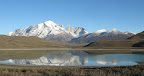 |
| Taken from Laguna Amarga, just before entering the park. |
The minibus dropped us off near the very posh Hotel Torres at about 11:30 am. We hit the trail right away.
The hike went up the Ascencio river valley to the camp site. We passed Refugio/Campamento Chileno on the way and noted that the refugio was already closed for the season. Not a problem since we were planning on camping anyhow. We made it to Campamento Torres (7 km) and set up our tent in a nice wooded area with a stream running through it for fresh water. Then we continued up to the lookout onto the towers; partly this was to see them up close and partly it was to check out the trail to see how doable it would be before sunrise the next morning. This was a fairly steep scramble but we decided that it would be possible at dawn. Good news!
We headed back to camp, had dinner and prepared to go to bed. Joe decided to have a look at the stars and came back to tell me that I had to come see. It was an amazingly clear night and almost a full moon. The moonlight was so bright that we had visible shadows and were able to take a photo of the mountain.
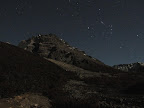 |
| Photo by moonlight: note the upside-down Orion constellation |
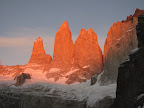 |
| Torres at dawn |
We headed back down and packed up. Instead of going just to Chileno, which was totally deserted, we decided to press on to Cuernos. Our day two ended up being quite long as a result - 17 km. Too long - my left achilles tendon was aching by about the 12 km mark. By the time we got to Cuernos, I was really hobbling.
After camping at Cuernos, we headed over to Campamento Italiano (5.5 km). To give my foot a rest, we didn't do any exploring that day. The next day was rainy and very grey so we hiked a short ways up Valle del Frances to see the glacier. We heard pieces falling off periodically making very loud thunder-like noises. We decided that further trekking into the mist would reveal little of interest other than the inside of clouds and banks of mist.
 |
| Glaciar Frances |
We stayed another night at Italiano for more foot recovery time.
The next day, still wet and misty, we headed over to Paine Grande (8km) and set up camp here. At sunrise the following morning, we were treated to a great view of a misty Paine Grande Massif.

Because of my foot, we decided to shorten our trip and stay two nights at Paine Grande. We managed a short hike up the valley to the Galciar Grey lookout (6 km each way) and gawked at the huge glacier for a while.
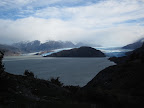 |
| Glaciar Grey |
The next morning we packed up camp and caught the boat out to meet up with the shuttle bus back to Puerto Natales.
Our revised trip was as follows:
April 14th, Day 1 - Hike to Campamento Torres, 7 km.
April 15th, Day 2 - Hike to Refugio/Campamento Cuernos, 17 km.
April 16th, Day 3 - Hike to Campamento Italiano, 5.5 km.
April 17th, Day 4 - Day hike up and down Valle del Frances. Hike to Refugio/Campamento Paine Grande, 8 km.
April 18th, Day 5 - Day hike up and back to the Glaciar Grey lookout, 12 km roundtrip.
April 19th, Day 6 - Leave via catamaran and minibus.
Now that we know what the terrain and distances are like, I would make the trip slightly easier for a return visit by camping for two nights at the bottom of each valley and day hiking up the valleys without the heavy backpacks. Alternatively, splurge and stay at the refugios so that we don't need as much gear. This would also have to be done earlier in the season though because the refugios were shutting down for the winter when we were there.
All in all, an amazing hike.
Sight seeing at Perito Moreno Glacier
Labels:
Chile 2011
After returning from the Torres del Paine hike, we headed over into Argentina. After a 5 hour bus trip, we were in El Calafate. From here, we decided my foot still needed more rest. So, we took a tour to Perito Moreno Glacier at the south end of Parque Nacional de los Glaciares.
After a 2 hour ride in a minibus, we hopped on a boat to get up close and personal with the glacier (about 300 m away from it). The visible face of the glacier is about 70 m high and truly an awesome sight.
After a 2 hour ride in a minibus, we hopped on a boat to get up close and personal with the glacier (about 300 m away from it). The visible face of the glacier is about 70 m high and truly an awesome sight.
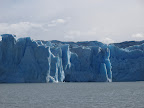 |
| Part of the south face of Perito Moreno glacier |
After the boat tour, we were dropped off to the main visitor attraction area. Here there are extremely sturdily built walkways for observation of the glaciar from the east side so that both south and north faces can be seen.
It isn't the largest glacier in the park though. Viedma and Upsala are over three times its size. It is the main tourist attraction partly for historical reasons (see Francisco Moreno on wikipedia or google) but also because it happens to be easily accessible. The glacier is also special because it is still advancing, with a speed of about 1.5m/day. It doesn't really seem to more forward though because bits and pieces are continually falling off and crashing into the water making quite spectacular splashes.
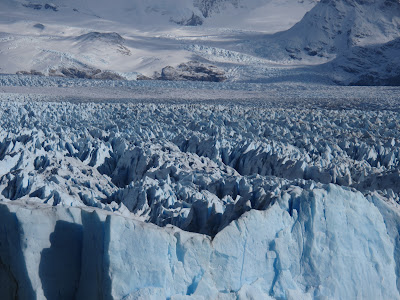
Although we didn't join in, there is also surface trekking on the sides of the glacier. The edges are relatively smooth but the top surface is extremely jagged.
 |
| Joe photo graphing the glacier from the walkway |
Because we were there in low season, there were really not very many other people there. A poster in the gift shop enlightened us as to the necessity of robustly built walkways - it showed them at high season totally jammed with tourists. We were very glad to be there at low season - it was a beautiful day, too, with a high temperature in the upper teens.
The walkways provided us with a sense of just how massive the glacier really is.
 |
| Perito Moreno Glacier overview Click to go to picasaweb and see the larger version. |
Although we didn't join in, there is also surface trekking on the sides of the glacier. The edges are relatively smooth but the top surface is extremely jagged.

All in all, well worth a visit! (I recommend low season though - the poster made the walkways at high season seem somewhat daunting.)
Subscribe to:
Posts (Atom)